Khutbah given at Masjid Al Bukhaari, West Palm Beach, Fl
By Abu ‘Abdis Salaam Siddiq Al Juyaanee

Khutbah given at Masjid Al Bukhaari, West Palm Beach, Fl
By Abu ‘Abdis Salaam Siddiq Al Juyaanee
From the seminar The Minhaj of The Salaf in Raising Children at Masjid Uthaymeen, Trenton, NJ
The Shaytaan wants that the children of Aadam stray with a far staying and not a near straying (one that’s close to the truth). Allaah stated: “And the Shaytaan wants to lead them far astray.” However we are not to think that the Shaytaan commands (the people) with (going) far astray from the onset. Rather (he does it) in stages. So he commands with Fisq (corruption) and the lesser acts of disobedience. Then (he commands with) the major sins. Then (he commands with) the disbelief (in Allaah). We ask Allaah to protect us. Based upon this the ‘Ulamaa have said: The acts of disobedience are the Bareed (path) to al-Kufr…The scholars have mentioned that the acts of disobedience are the path to al-Kufr and the Shaytaan takes the person in stages, step by step until the point he destroys him.”
Question posed to Imaam Ibn Baaz (may Allaah have mercy upon him):
Question:
The mentioning of the wealth always come before the mentioning of the children in the Qur’aan although the children are more precious with the parent than his wealth. What is the wisdom behind that?
Answer:
The fitnah of the wealth is more (than the fitnah of the children). That’s because the wealth aids him upon fulfilling the prohibited desires and other than that. This is different from the children. Indeed it’s possible that the parent is tested by them and he disobeys Allaah due to them. However the fitnah of wealth is greater and more severe. Based upon this, Allaah began with (mentioning) the wealth before the children. Like in His statement: “It is not your wealth or your children which gets you closer to Us.” (Saba: 37) And His statement: “Indeed your wealth and your children are only a test.” (At-Taghaabun: 15) And His statement: “Oh you who believe, do not let your wealth nor your children divert you from the remembrance of Allaah. Whoever does so then those are the ones whom are the losers.” (Al-Munaafiqoon: 9) Continue reading
WE ARE PLEASED TO ANNOUNCE
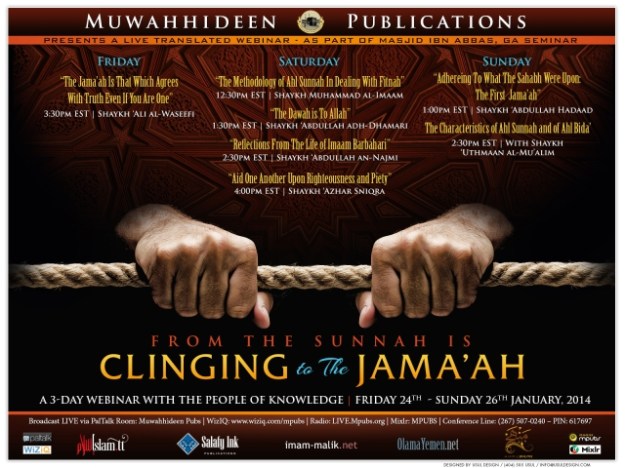
Our Shaykh Muhammad Ramzaan al-Haajiree (hafidhahullah) has agreed to be added to this weekend’s MPUBS webinar in conjunction with Masjid Ibn ‘Abbas, GA Seminar
Topic:
The Effect of Aqeedah and Manhaj Upon The Individual and The Society
Sunday 26th January, 2014
12pm EST/ 1pm T&T/ 5pm GMT/ 8pm Saudi
On the authority of Abu Hurayrah (may Allaah be pleased with him), the Messenger of Allaah (sallallaahu ‘alayhi wa sallam) stated: “Do not make your homes graveyards. Indeed the Shaytaan flees from the home which Soorah al-Baqarah is recited in.” (Saheeh Muslim 780)
1. Encouragement to pray Salaatun-Naafilah (superogatory prayers) in the homes.
2. The prohibition of taken the house as a place that is abandoned like the graves, you do not pray in it nor remember Allaah in it.
3. Encouragement to recite Soorah al-Baqarah in the house. Continue reading
On the authority of ‘Alee (may Allaah be pleased with him) that the Prophet (sallaahu wa alayhi wa sallam) stated: “Whoever narrates on me a narration and he sees it to be a lie then he is one of the two liars.” (Ibn Maajah Authenticated by Imaam al-Albaani).
This Hadeeth is a stern warning against the one who narrates a narration that the person himself sees to be a lie. The threat is directed towards him. Therefore he is one of the two liars. That’s because he agreed with the lie by narrating on him (the one who he got the narration from) that which he knows to be lie. So the one who narrates on others has one of three situations: 1. He knows the truthfulness of that which he narrates or it overwhelms his belief that (the information) is true so he narrates it. The threat is not directed towards this individual, nor any blame or fault on his end. Even if it was to become clear to him (afterwards) that the narration/news is a lie, there’s no sin upon him. Continue reading
The Muslim is in need of three matters when there is differing, in order for him to know the correct path:
Firstly: The correct knowledge and not the pretend knowledge. It is not possible for you to traverse upon this path except that you have learned and you know the truth from the misguidance.
Secondly: Having patience and being firmly established. Not wavering even if you are afflicted by that which befalls you. Indeed you are to remain patient no matter how much it costs you (to do so).
Thirdly: Do not be deceived by the large amount (of people who are upon something). Indeed you only look at who is upon the truth. Continue reading
Listening to news (about a person) without any proof or evidence is oppression. That it is said so and so said this, like some have said to others that I said such and such. Say to this person bring me the recording, or bring the book (that the statement is in) to establish this claim.
To attribute something to a person without any proof and you say: It was stated to me by those who are thiqah without naming who these individuals are, we say name your men to us! Don’t make the matter one that is not clear. It’s a must that you have a proof. You’re speaking about the honor of a person, therefore it’s a must that you bring the proof and evidence! The burden of proof is upon the claimant. This is the Judgment. Indeed the judgment is for Allaah. Use the Sharee’ah as a judge regarding your statement! Continue reading